


What Determines Reach?
Are you shadow-banned, algorithmically limited, or is your reach the pure product of the content that you produce? There is likely no other question we want answered more than “what determines reach,” but it is the answer that is the most evasive.
The algorithm is one of the most guarded secrets in civilization. You will probably have the remaining UFO files in hand before you know the details of the algorithm. Every platform has a secret algorithm that is purportedly designed to increase engagement by helping users find the content they are interested in engaging with.
However, for many of us, this seems demonstrably false. We have almost no engagement or reach; our posts might as well be private diaries.
Can We Even Answer the Question?
Maybe we can answer the question in part. The platforms and some “experts” would tell you that if you have no engagement, then it’s your content. Certainly, without algorithmic interference, this should be true. But how can we test that assertion?
We need a control, a place to post content where reach is not algorithmic. Not many places are left where this is true, but there do remain Reddit and Hacker News. My content posted on these platforms often does orders of magnitude better, such as here, here (posted by someone else), and here.
So why not just post there all the time? Well, they each have their downsides as well. Especially Reddit, where I’ve been banned from numerous forums where my content did well.
Another Signal for Your Content's Merit
On a platform like X, if your replies seem to generate normal engagement, and your posts are essentially the same content, then it would appear that it is not necessarily a content or topic problem. The engagement with your replies has shown there are people interested in what you have to say.
But where are they? Well, you know who they are and where they are. You know the like-minded people on these platforms, and yet, the sophisticated AI algorithms that know everything about our lives, track every action we take, and everything we view, somehow cannot find a single person who wants to engage with your content. This just seems absurd.
What We Actually Observe
The use of reputation points has got to be one of the most insidious inventions ever. You are punished for some unknown characteristics about you that you can never know, while the merits of each individual post you may put hours of effort into are simply ignored. And inversely, there are others who can post anything completely valueless that gets virally promoted to huge audiences.
There is no evidence that pinning or highlights give any boost. I have personally been unable to verify this, and there is nothing in the codebase that we can see.
What More Can We Discover?
I’ve made an attempt to do something that is just slightly better than a guess at the engagement patterns we see for users on X. I wanted to get some real data to better understand how my account performs compared to everyone else, hoping to answer the question of whether my engagement is truly atypically bad.
I enhanced my X-Filter extension to collect metrics data as I browse profiles. What follows is an analysis of that data. Consider it no more than an experimental exploration; it is not by any means a properly structured study, as the means to do that would be prohibitively expensive due to X’s API costs to get all the data I would want to analyze. Nonetheless, we still have some rather interesting data points.
A Mostly Incorrect Analysis of the X Algorithm
Our first sample is 10k posts from 100 different profiles, which comprise each profile’s last 100 posts. This collection is approximately the best I can do using a passive collection method. The profile sample is a bit ad hoc, representing a mix of large, well-known accounts, accounts I’ve randomly come across that appear unusual due to either large or small engagement, and a sample of others I follow in my areas of interest.
Overall Patterns and Content Performance
The median engagement rate for this sample is 1.7%, measured as any interaction against the number of views of a post. The median views per follower on a typical post is 9.5%. The 63.7% hit concentration is a measure of how much the engagement is driven by a few viral posts on each account.
Most accounts have some baseline, consistent reach and a few occasional posts that go significantly beyond their typical.
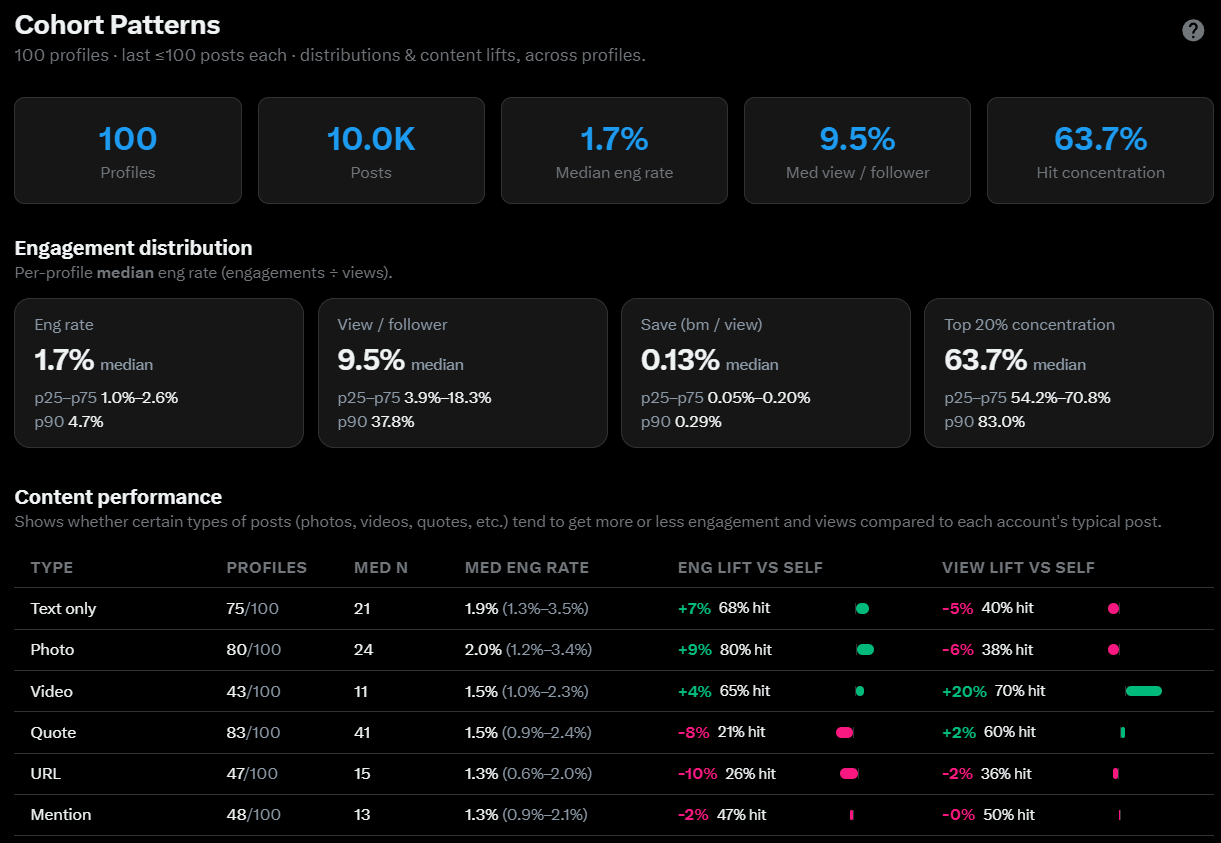
The performance by content type somewhat aligns with the anecdotal recommendations common on X. However, there are some interesting subtleties. For example, photos do tend to boost engagement, but they also tend to have less reach; more people interact, but fewer people see the post.
Videos get a significant reach boost, but don’t benefit as much from engagement. Quotes, URL links, and mentions underperform compared to others. Note, we don’t know why this is the case; we don’t have the means to distinguish the reason from our data.
For example, URLs may perform worse due to the fact that people tend to post less information in a URL post; they want you to visit the URL to get the information. So, the lower engagement here might be organic versus algorithmically driven, as there seems to be no remaining link weighting in the latest open-source algorithm.
The idea that X penalized all links was misinformation spread around by lots of “algorithm whisperers” engagement farming. In fact, we can even find in the old algorithm where it boosted links associated with news.
Reach, Impact, and Audience Size
Where things get interesting is when we begin to compare stats across profiles. We would expect some accounts to naturally perform better than others. However, the difference between accounts is so extreme that it defies explanation.
Below is a logarithmic view of reach versus followers. The y-axis is the median number of views the account receives per post, and the x-axis is the number of followers the account has. This gives us a diagonal efficiency rating for views per follower. Account sizes are grouped into buckets: Small (< 10K ), Mid (10K-100K) , Macro (100K - 1M) < Mega (1M+) .
With an overall median of 9.5% of views per follower, the 10% line on the graph is an approximate divider for overperforming and underperforming accounts.
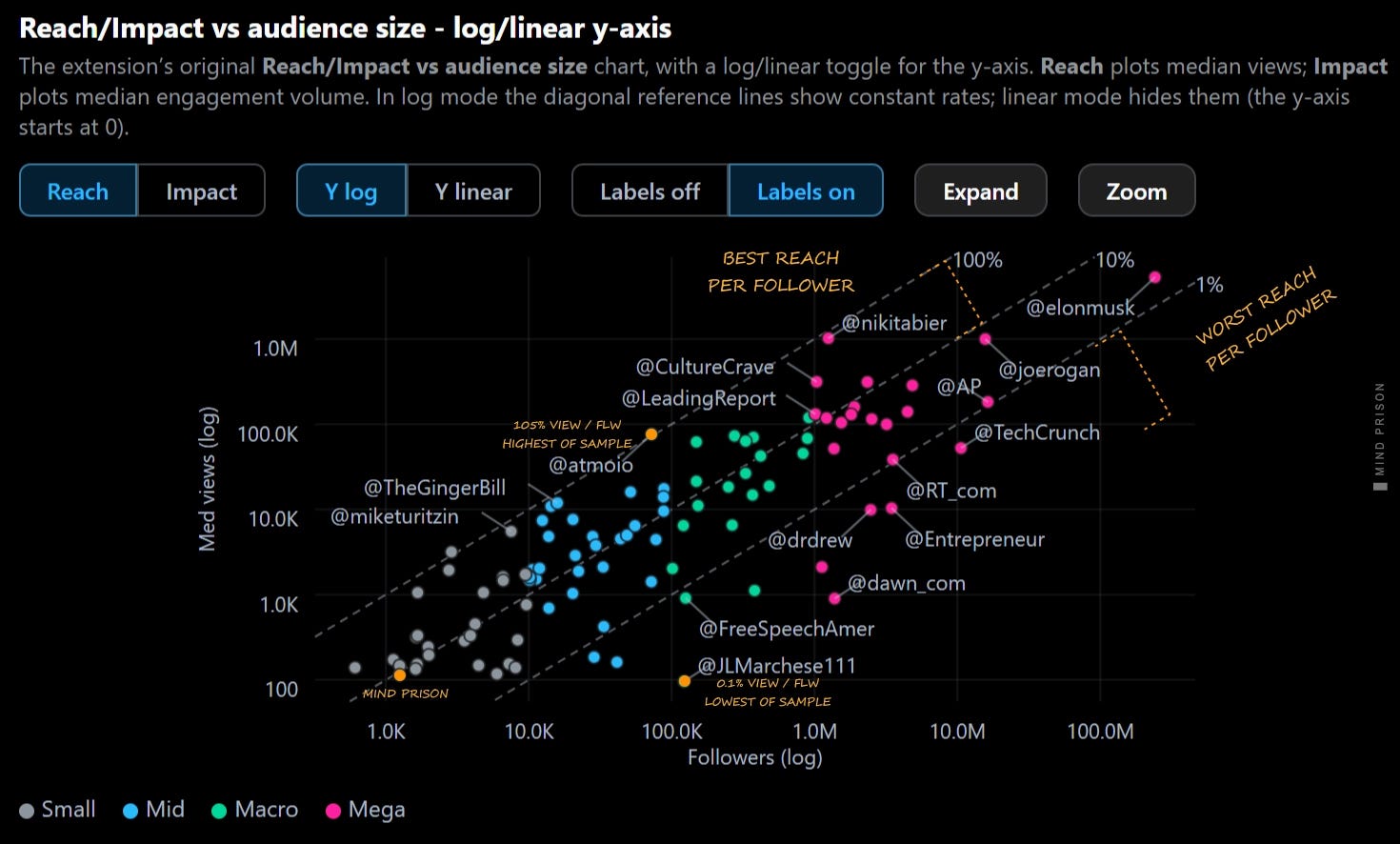
We can see that Elon Musk has the highest overall reach, at about 5.3M views per post, but this is mainly due to having 240M followers versus efficiency. Account atmoio is receiving 105% of views per follower, which is the highest of this sample.
And Then Came the Shadow-Banned
Below the 1% line are extremely low-performing accounts. Several of these are news or magazine accounts, but that alone doesn’t explain such low performance, as there are also such accounts that perform well. We also have Dr. Drew in this category, performing far below typical.
But the worst-performing accounts I’ve encountered on X are still substantially worse. Dawn_com is the absolute worst large account I’ve found. At 1.4M followers, this account has a zero-engagement rate of 20%, meaning 1 out of 5 posts from this account receive no likes, no comments, nothing. How does this happen?
And then we have this bizarre account, JLMarchese111, that has 122K followers with about a 70% zero-engagement rate!
Interestingly, my own account, Mind Prison, is orders of magnitude better than these accounts, performing approximately at the median level. However, it certainly doesn't feel like it. But this is what motivated me to collect this data, as I wanted to find out. Further down, I will explain why I think this is the case and why most of us perceive ourselves as shadow-banned.
Impact: Who Makes Conversations and Engagement Happen
Reach and followers tell us less about who actually is influencing conversations and reactions on the platform. An account may have a very large reach, as in their posts are being shown to lots of people, but without engagement, their posts are just being ignored; they aren’t having a measurable effect.
This is the view of the same sample of accounts, but by impact instead of reach. It tells us who is making a difference. The points shift quite a bit because reach and impact differ greatly for some accounts.
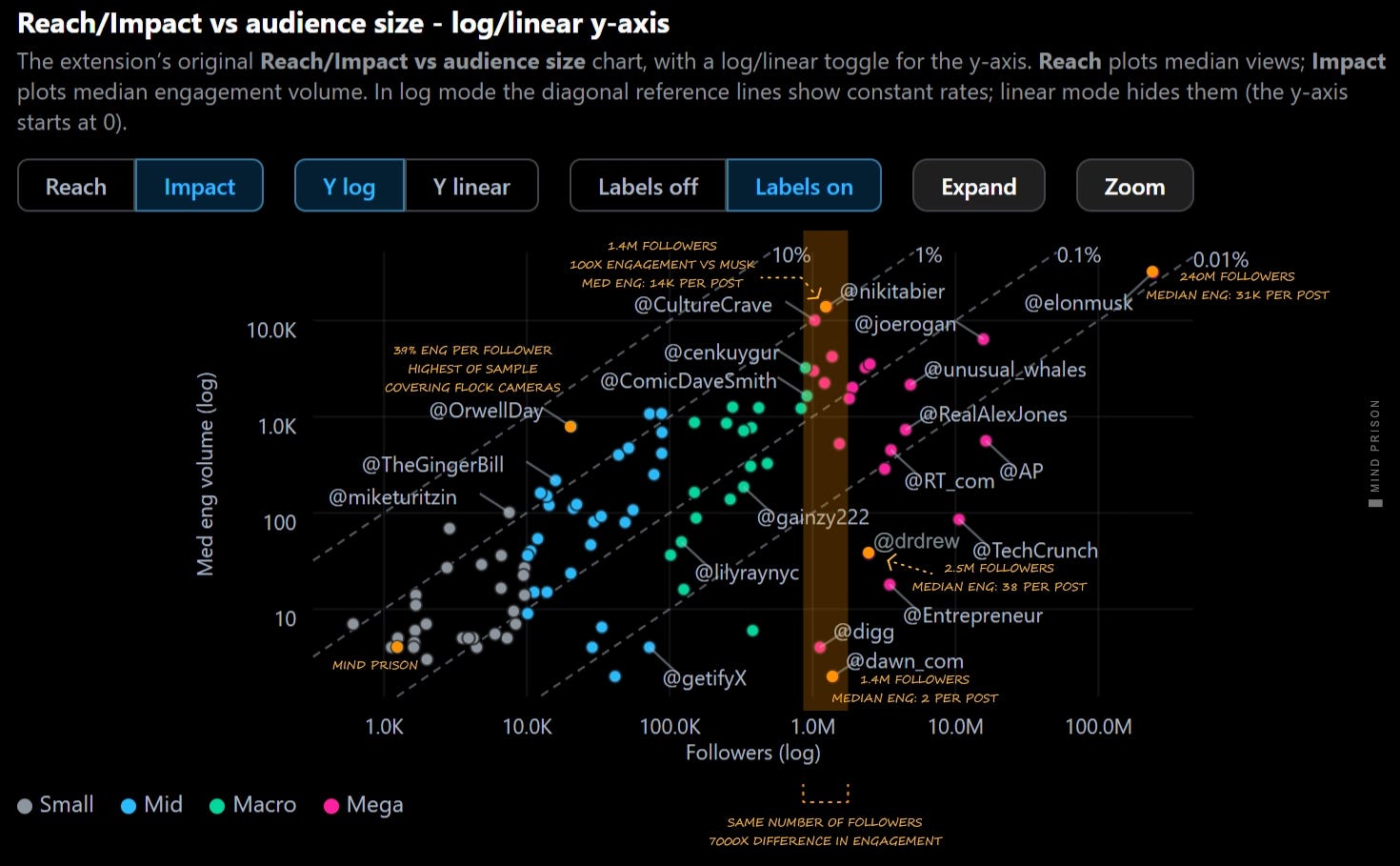
Elon Musk dominates here once again, with 31K median engagements per post. Nikita Bier, at 14K, is extremely efficient, shifting significantly upward on this graph, closer to Elon and separating from Joe Rogan’s. Nikita’s account is about 200x smaller than Elon’s, but is achieving nearly 50% of Elon’s engagement volume.
If we look vertically at any slice of the graph, we see the discrepancy in engagement between same-size accounts. Dawn_com is essentially the same size as Nikita’s account, but at 7,000 times less engagement with an engagement volume of 2 versus 14K.
And if we look horizontally, we can identify much smaller accounts outperforming larger accounts, such as OrwellDay, at 20K followers, outperforming Alex Jones at 4.5M followers.
Do Premium Accounts Have Better Reach?
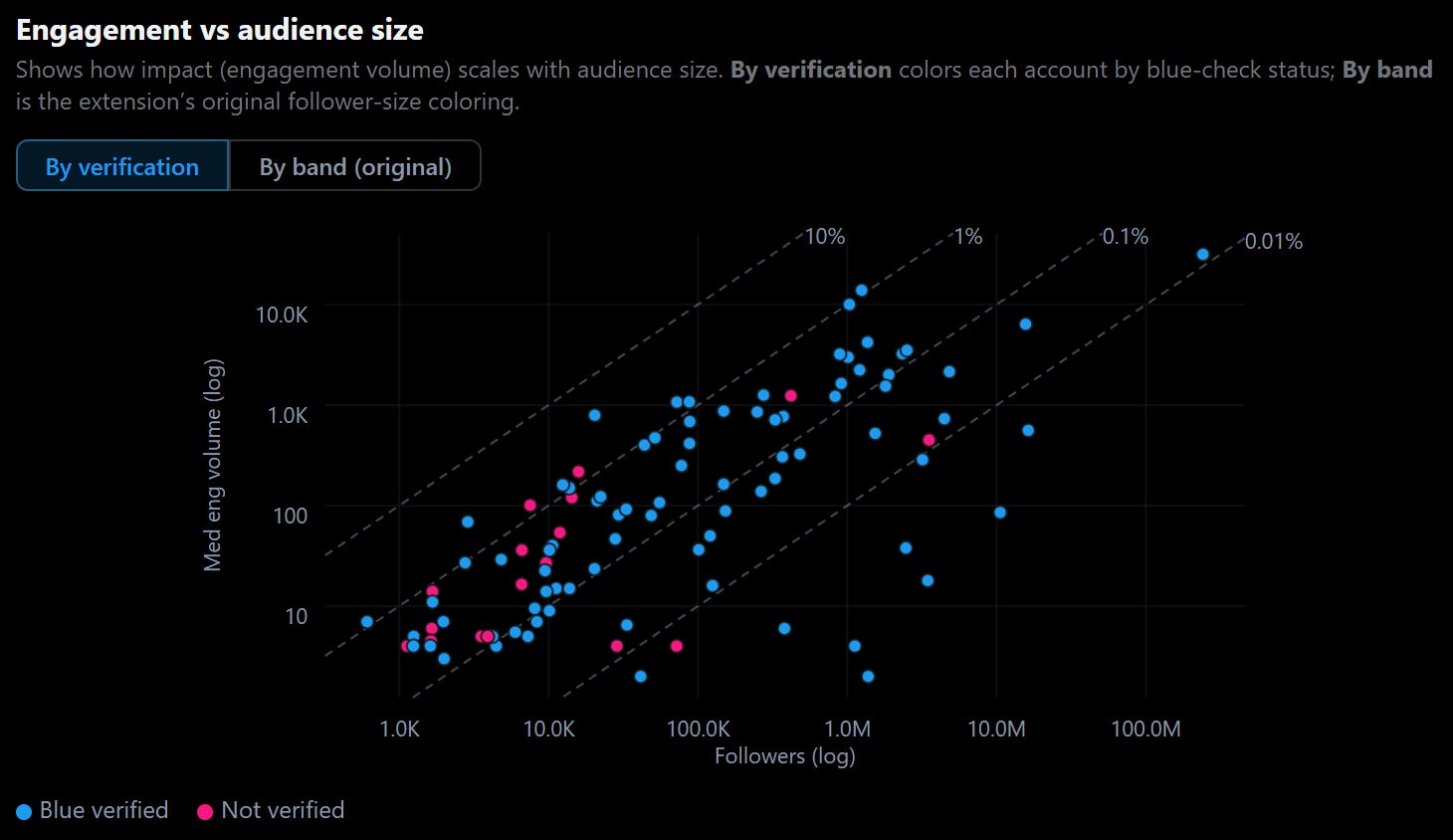
X has never claimed that premium account posts have better reach, only that replies have better reach. Nonetheless, many may wonder if you are severely penalized for having a non-premium account.
From this very small sample, there doesn’t seem to be any evidence of a significant penalty or even any penalty at all. The red dots indicate the non-premium accounts, and there isn’t a clear pattern that suggests any type of penalty being applied. There is a general, broad scattering of engagement, just as we see with premium accounts.
Sample 2: All 100 US Senators
The next sample is of all 100 X profiles for the 100 US Senators. This gives us a sample collection all within a similar topic area, but variance of reach and impact remain extreme.
John Fetterman
54% views / follower: Highest of this sample. Nobody else in this sample is close to the same reach.
6.7% engagement rate: This is a high engagement rate, but there are others with higher and much less reach.
Kirsten Gillibrand
0.5% views / follower: Lowest of this sample. Fetterman is about 100 times higher.
Bernie Sanders
1.8% views / follower: At nearly 12M followers, Sanders still has less reach and engagement than Fetterman at only 0.5M followers.
Pete Ricketts
15% views / follower: While being the smallest account, Ricketts high views per follower allows his account to perform as well as some accounts with 200K followers.
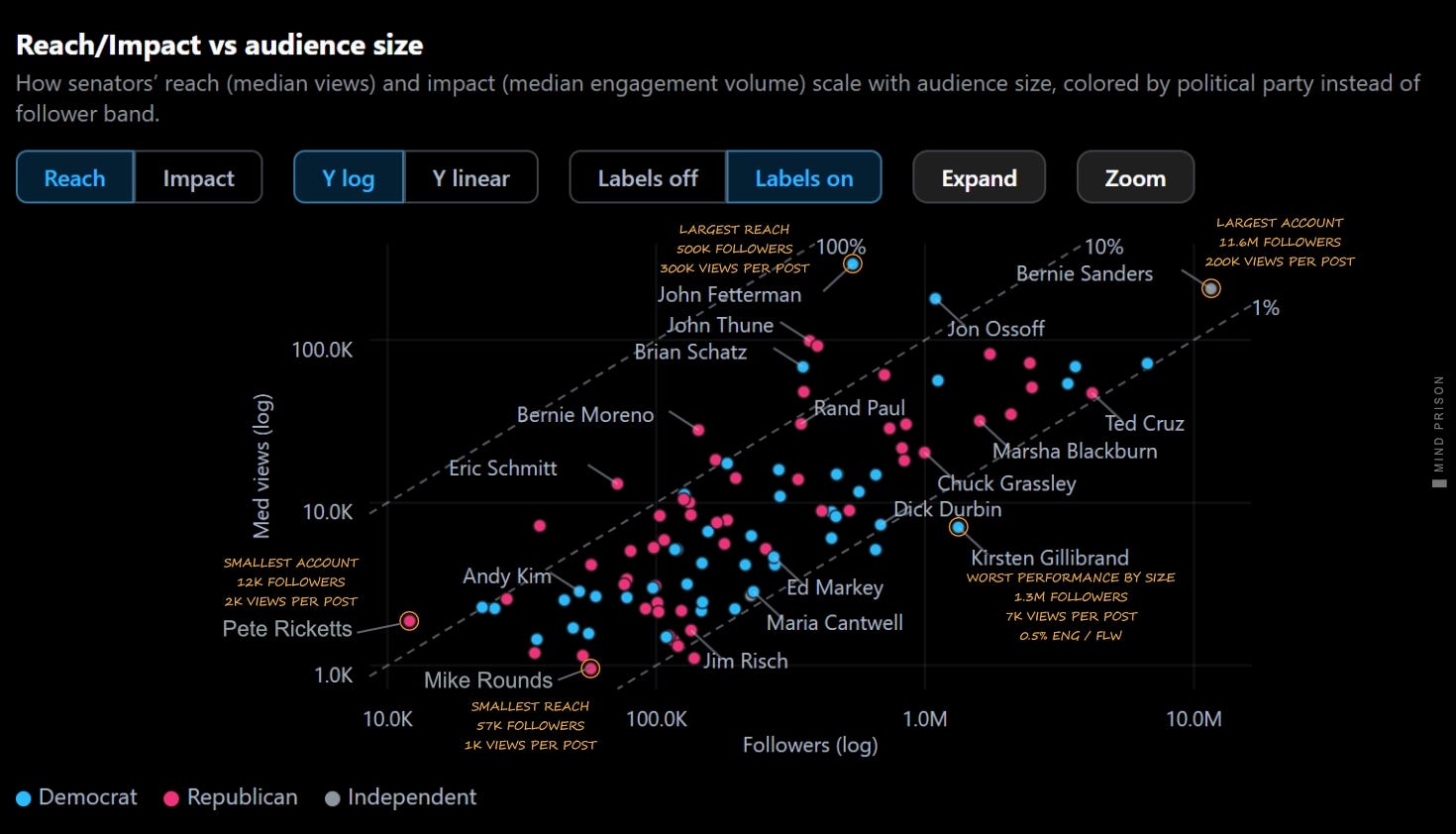
There are some interesting contrasts in the data. For example, Fetterman’s reach is the highest of the sample by a very large margin. The question is why? We cannot explain it by the data, but what is odd is that Senator Warnock has an engagement rate of 10%, which is also the highest in the sample, but with a view rate that is 1/5 of Fetterman’s.
It is mostly assumed that engagement is the strongest signal to the algorithm for increasing the reach of your posts. However, the data here is not in alignment with that premise. Such contrasting outliers are not uncommon in the data.
We might guess that engagement patterns differ for different groups of followers. This would not be surprising, but it would be unexpected for them to differ by orders of magnitude, especially when we have a sample set of profiles that should have overlapping interests. We would expect Warnock and Fetterman to have an overlap of followers, for example, but we do not have the means to test that given our limited collection method.
Political Bias
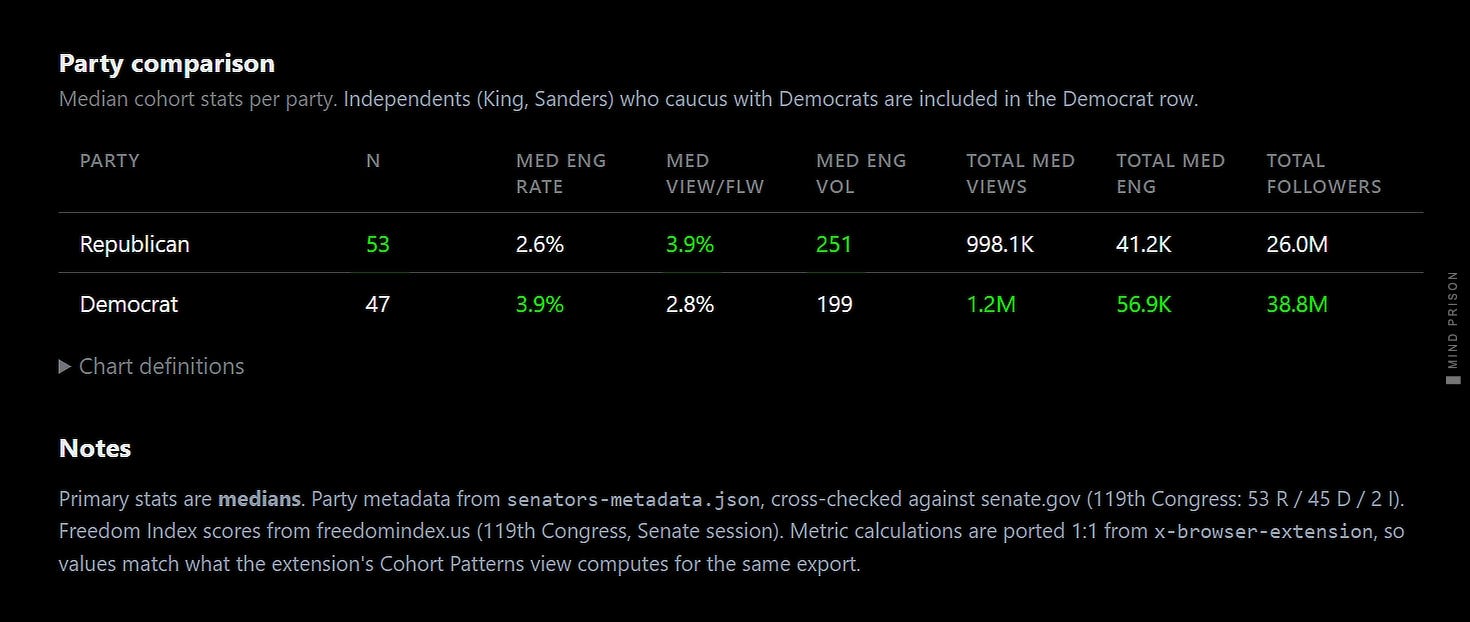
Does the data demonstrate any overt political bias in the algorithm? Due to the nature of extremes for both samples when looking at individual profiles, there does not seem to be any apparent bias that points in a particular direction. There are numerous oddities, but these types of oddities exist everywhere.
Below are the overall stats across parties, with each having some advantages by the numbers. If there is subtle bias, we do not have enough data to perceive it.
Winner Take All
The logarithmic charts allow us to see relative relationships across all account sizes, but we lose the clear perception of just how significant the difference is between accounts that perform well and those that do not.
For example, John Fetterman in our second sample is such an extreme outlier. We attempt to make this more apparent in the chart below, where we show that Fetterman’s engagement is equivalent to that of 81 other senators combined.
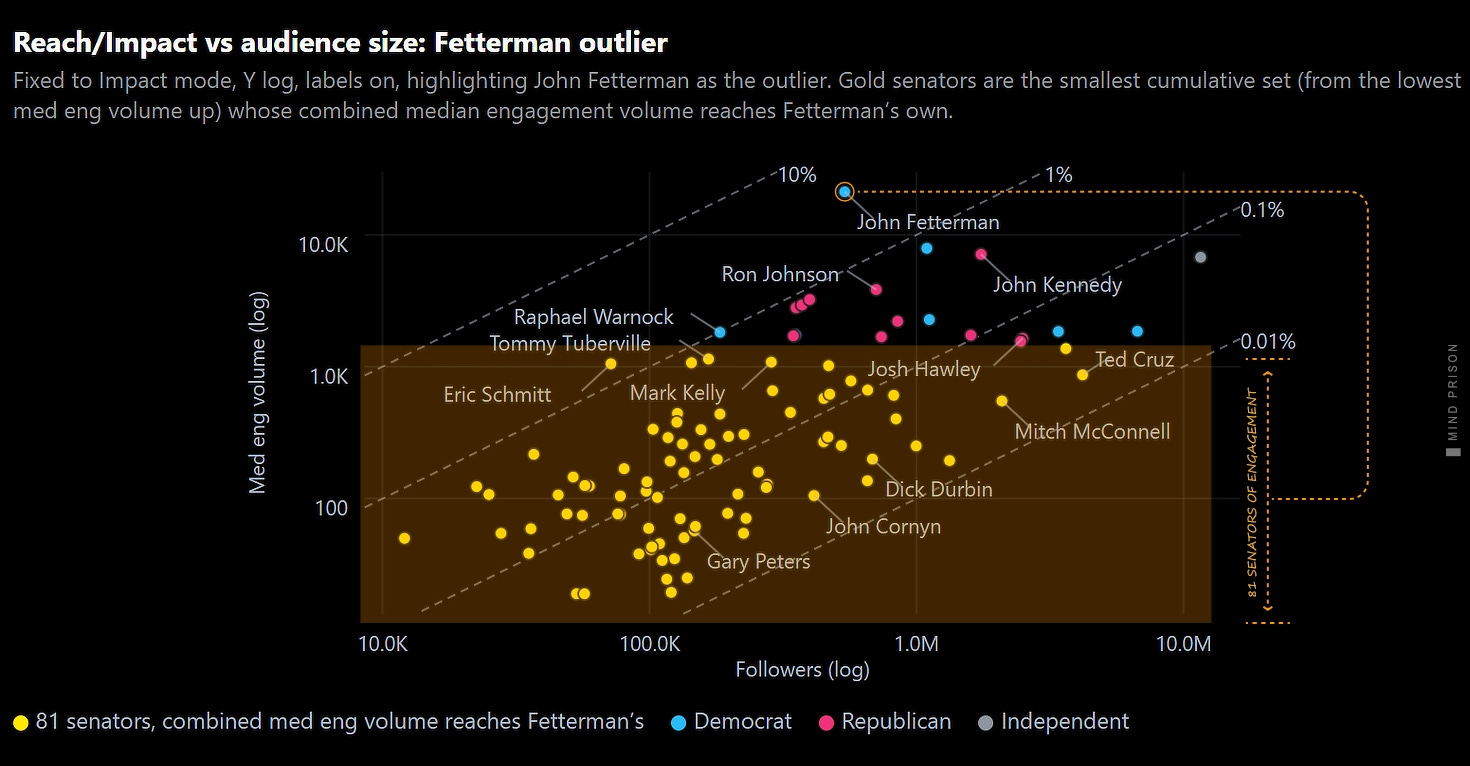
Such extreme disproportionate reach and engagement should make us question the wisdom of a society that continues to rely more and more on social media for information dissemination and public debate.
Whether this is algorithmically driven or social media celebritism and fandom, it does not bode well for reasoned intellectual discourse that entertains a breadth of ideas from the public.
The Linear View, What the Algorithmic Society Actually Looks Like
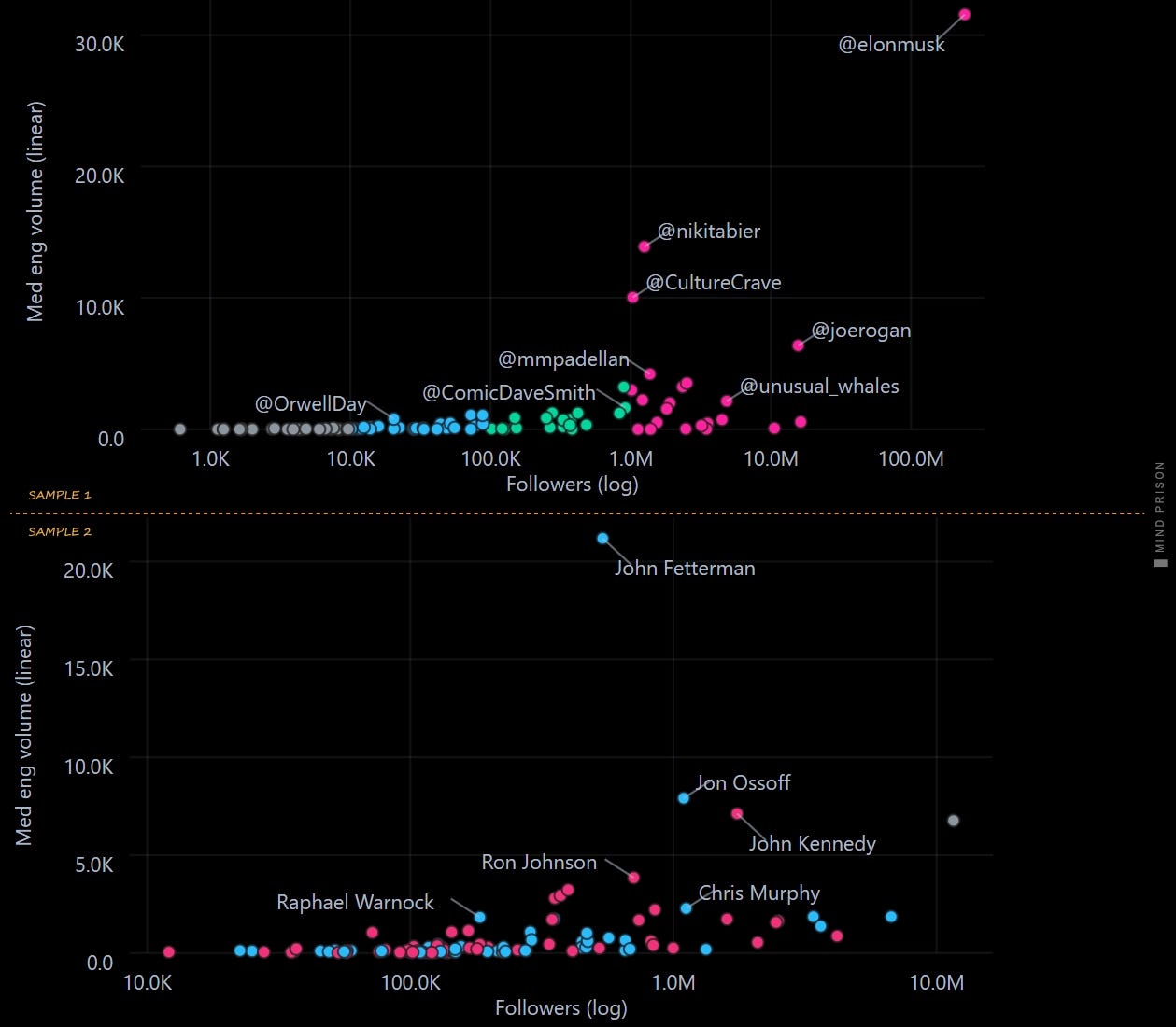
If we look at the data from a linear view, we can see more clearly the disproportionate distribution. There is only a very small minority that has visibility and can reach the general public.
Below is a linear view of both samples of engagement volume. In relative terms, most of us simply do not exist. Likely, all social media would graph similarly.
Why We Are All Insignificant
Previously, I mentioned that my own account, based on size, is not a significant outlier when it comes to its limited reach. Although, it certainly feels it is the case. Here are my thoughts on that.
The extreme disproportionate distributions leave the majority of users feeling insignificant. The “For You” feed, by design, is going to show you a larger subset of those who generally have better reach. This is a skewed view of reality.
But what makes it more painful is that within that subset will be accounts approximately your size, or maybe even smaller, posting on the same topics you post about, possibly far less eloquently or intelligently, all while having significantly greater reach with no explanation.
The chart below is representative of many small account engagement patterns. This is my Mind Prison account on X. We see that of the last 100 posts, only 1 did well. This is fairly typical from what I’ve observed.
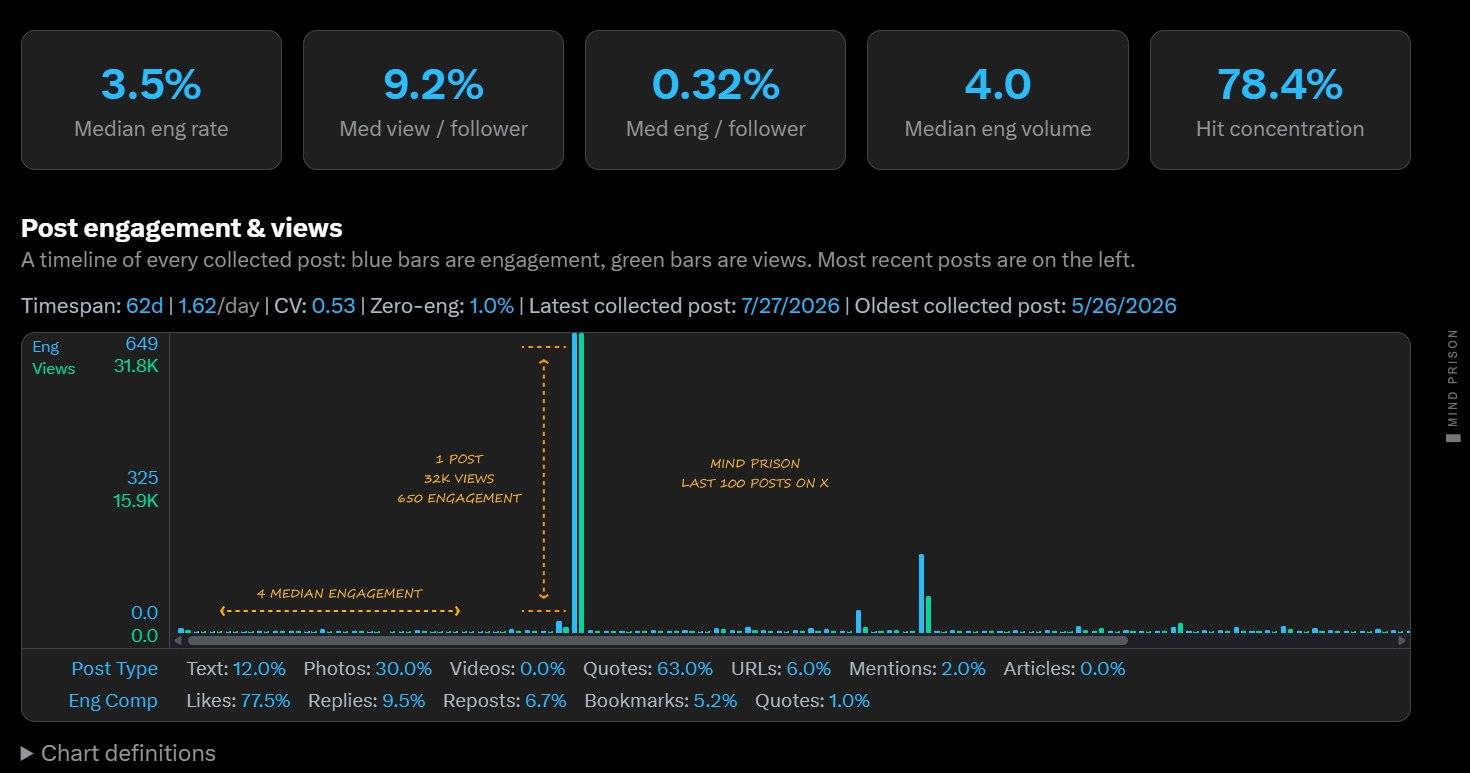
What is often frustrating is that such posts are no different in content than any of the others on the timeline that were virtually unseen. Is it simply a matter of luck and the odds, that one large account just happened to repost one of your posts?
This is only anecdotal, as I do not have the ability to track the data, but I’ve had my posts occasionally reposted by large accounts and still performed poorly. I am not sure that reposts always ensure access to the full reach of those who repost them.
And how do some others have unbelievably high, consistent views and engagement that are orders of magnitude greater? For example, how does the following happen? This very small account still has spikes in engagement, but the median view rate is extraordinarily high, while having a lower engagement rate than my account.
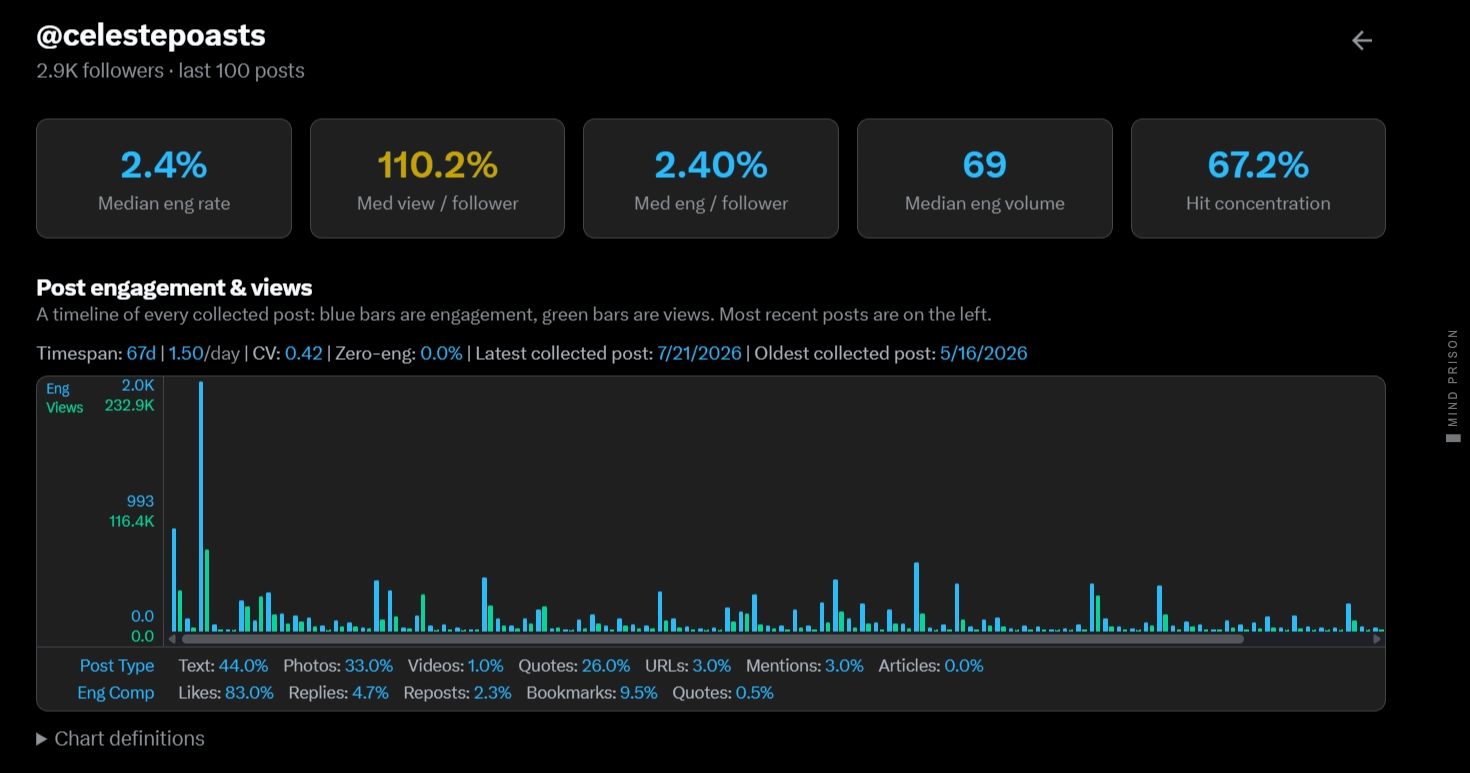
Is this purely organic or algorithmically driven? Ideally, we would deeply analyze the follower network, analyze who interacted and how, for example, who reposted their posts and how much reach they have. But that kind of probing is beyond what we can do with our extension. It would require collecting vast amounts of data from the X API, which likely would be in the tens of thousands in API costs.
The AI-Content Accounts
Despite all of the rhetoric about X not wanting AI-content automation, it still largely remains. X claims it wishes to eliminate automated AI content, but AI content often seems to perform better than everything else.
“X’s core value is providing an authentic pulse on humanity -- and using AI to programmatically engage with users without a human in the loop runs counter to our mission.” — Nikita Bier
The following is an example of a couple of very unnatural-looking profiles that use AI to make content. There is very little variability, no spikes in engagement that we generally see with other profiles. Is this an artifact of the algorithm preferring this content, or is it the result of these profiles botting their own engagement, or something else?
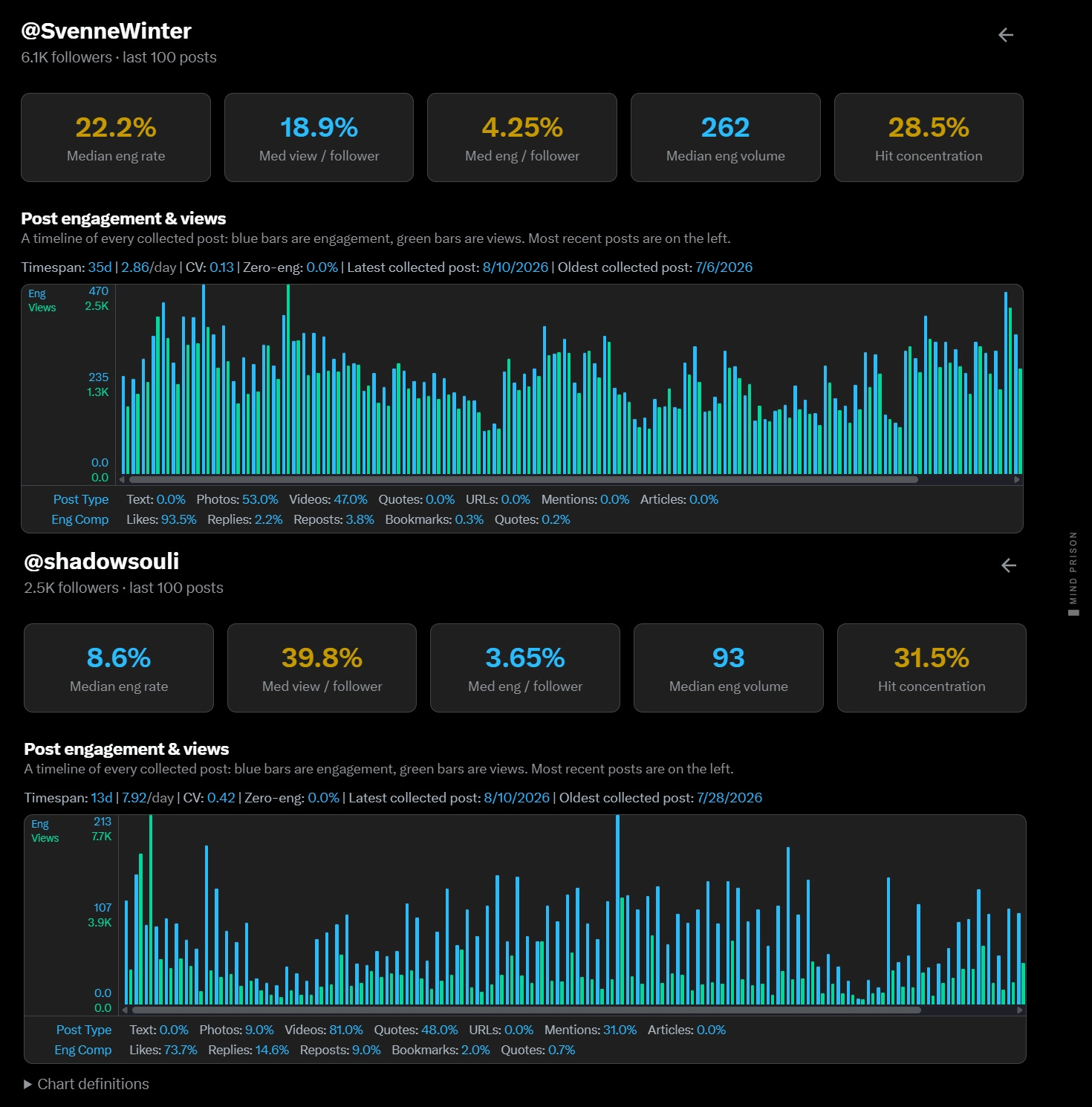
The above are some very unusual engagement patterns: high engagement and view ratios combined with unusually low hit concentration.
Furthermore, these accounts are likely being paid for such content under the old monetization program. It isn’t clear if the new monetization program will include this type of content.
And It Continues to Get Harder to Explain
Leo (Synthwavedd) is a pro-AI commentary account, but these numbers are astronomically unordinary. At 33K followers, it has nearly the reach of ZeroHedge at 3.3M and engagement levels above Alex Jones with 4.5M followers. Jones has a 0.02% median engagement rate per follower, compared to Leo’s 2.72%, which is 136 times higher.
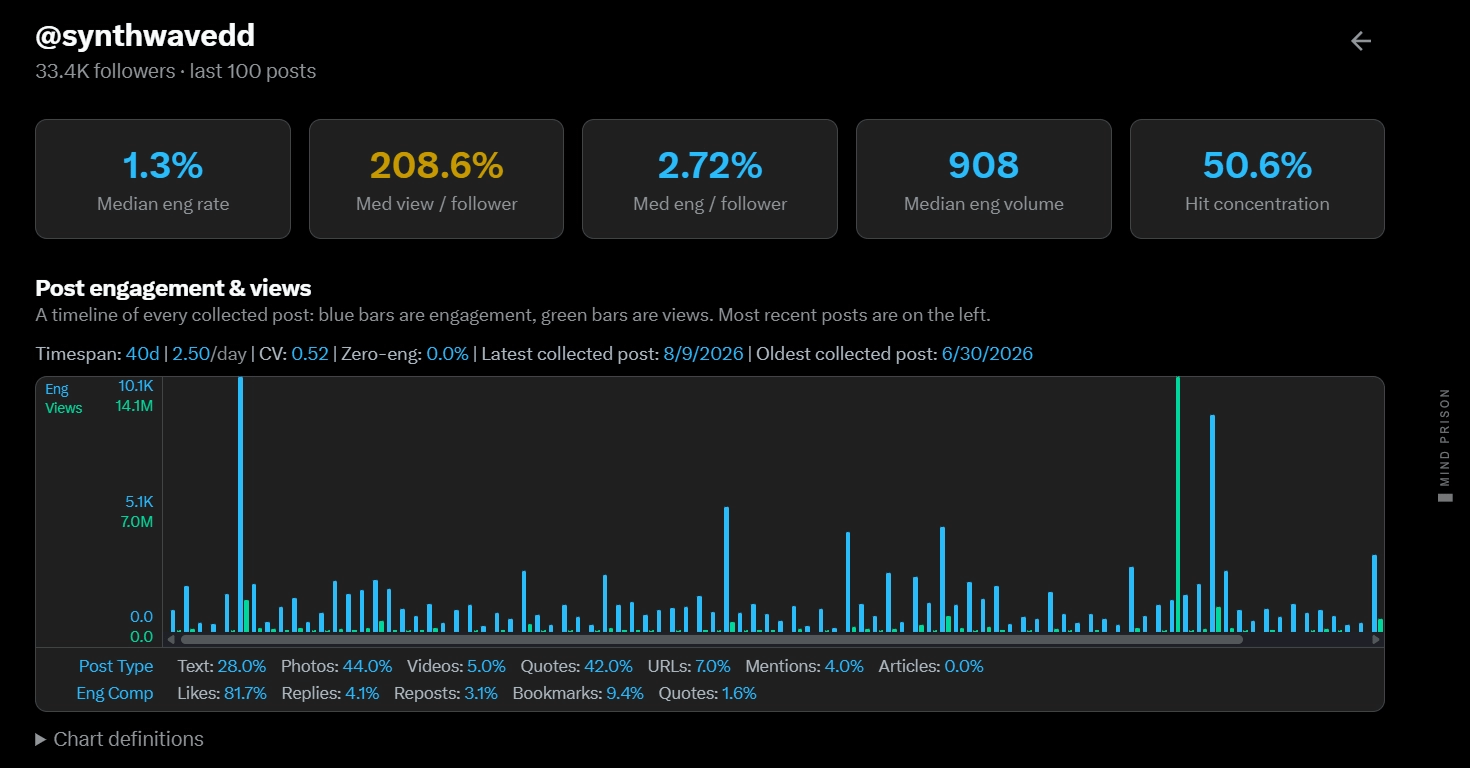
And here is a sample post of Leo’s, with zero reposts, and gets 28K views for a 33K account? What is going on here?
Additional Analysis
Cadence Versus Efficiency
Does the frequency of posting affect reach? Below are scatter charts for both sample 1 and sample 2. There does not seem to be any strong correlation between frequency and reach. A potential weak trend is visible, but there is still very high variability.
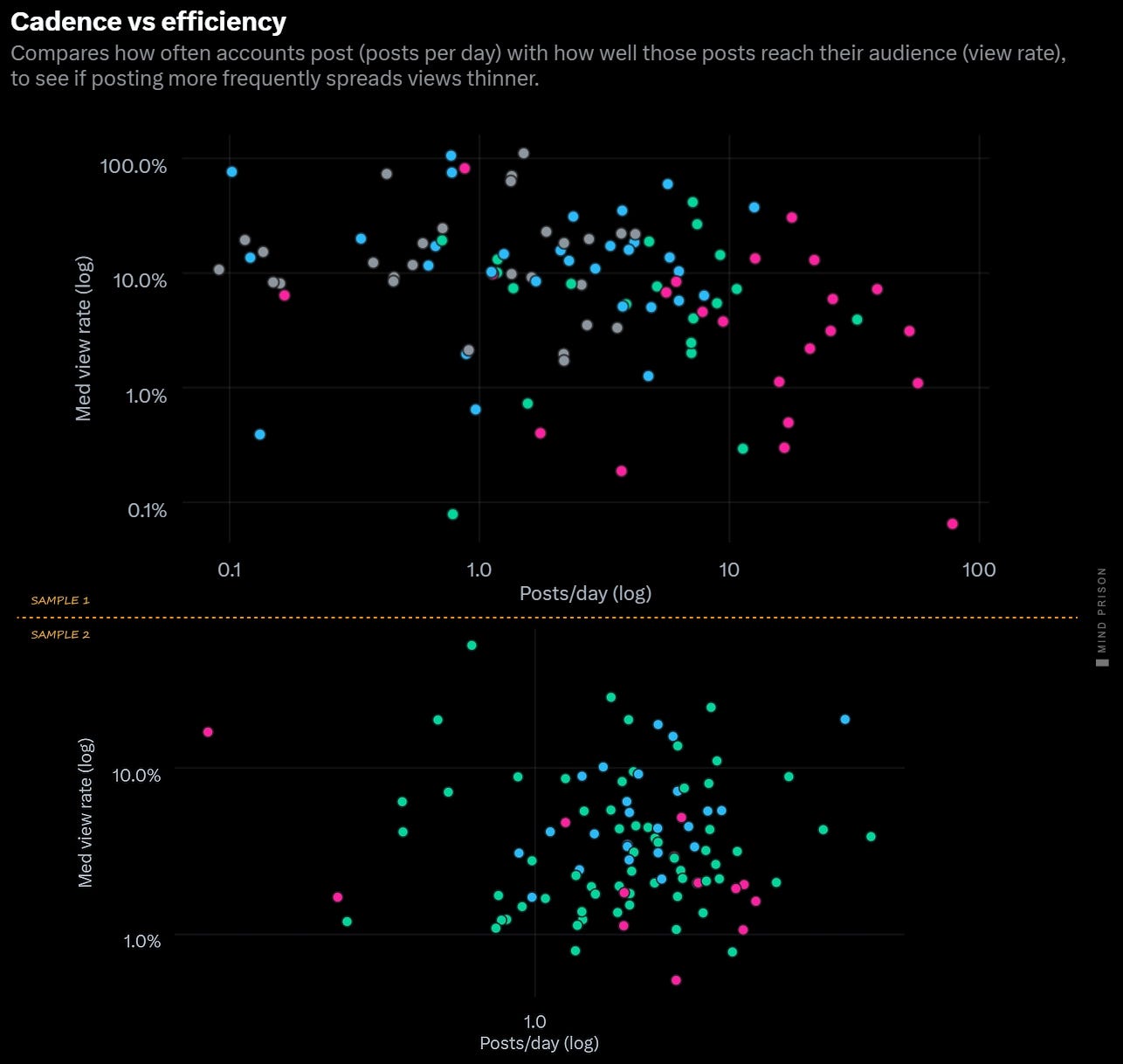
However, we are only measuring each profile’s original post content; reposts and replies are not part of this set, so we do not know how that might impact the results.
Content Performance for Both Samples
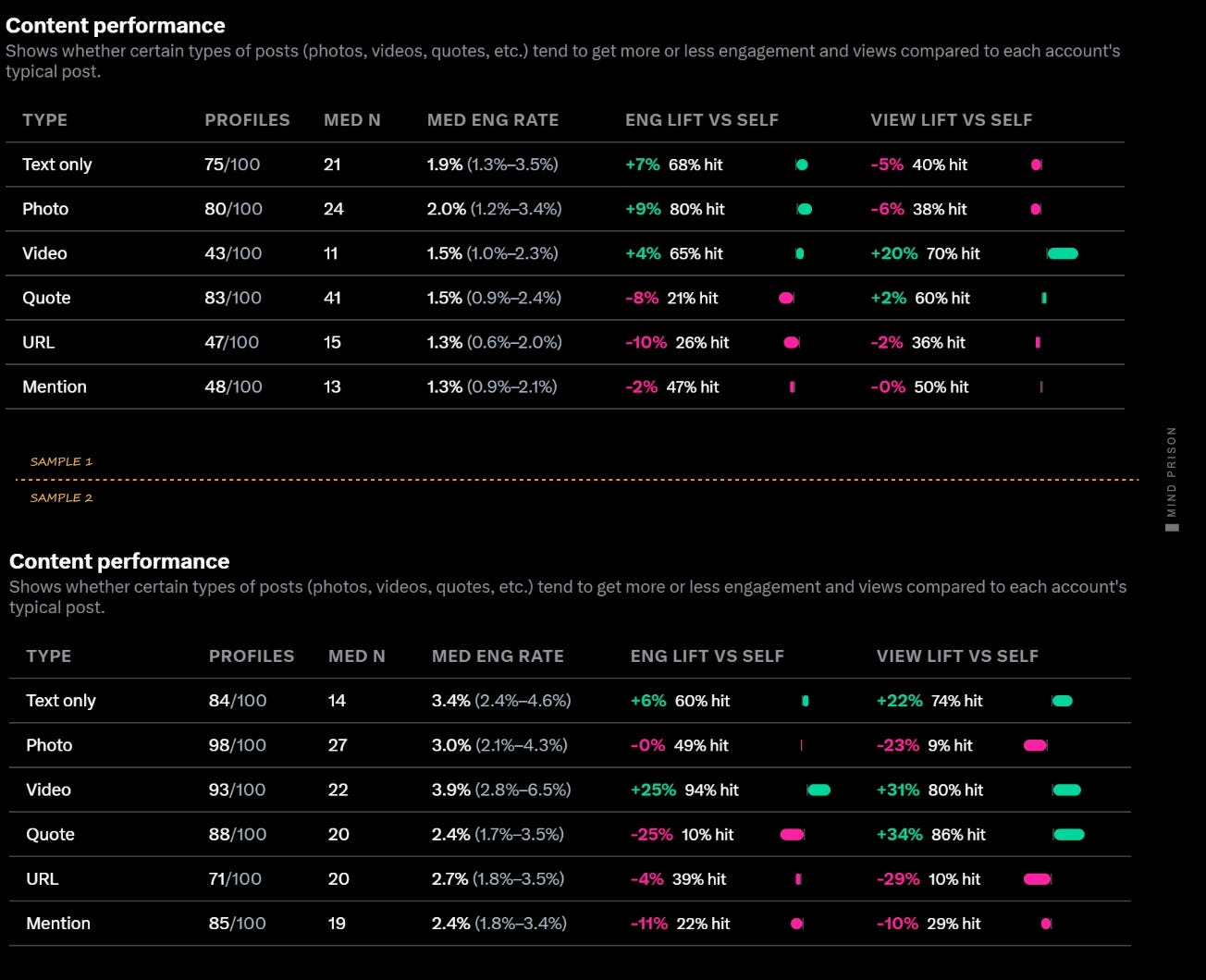
Across both samples, we see some trends. Photos tend to get less views, but sometimes boost engagement. Videos consistently get more views across samples. Both URLs and mentions are generally negative in both categories.
Quotes are a bit negative for engagement, but positive for views, and each effect is more pronounced in the second sample, which is our Senators dataset.
Account Size Effect for Both Samples
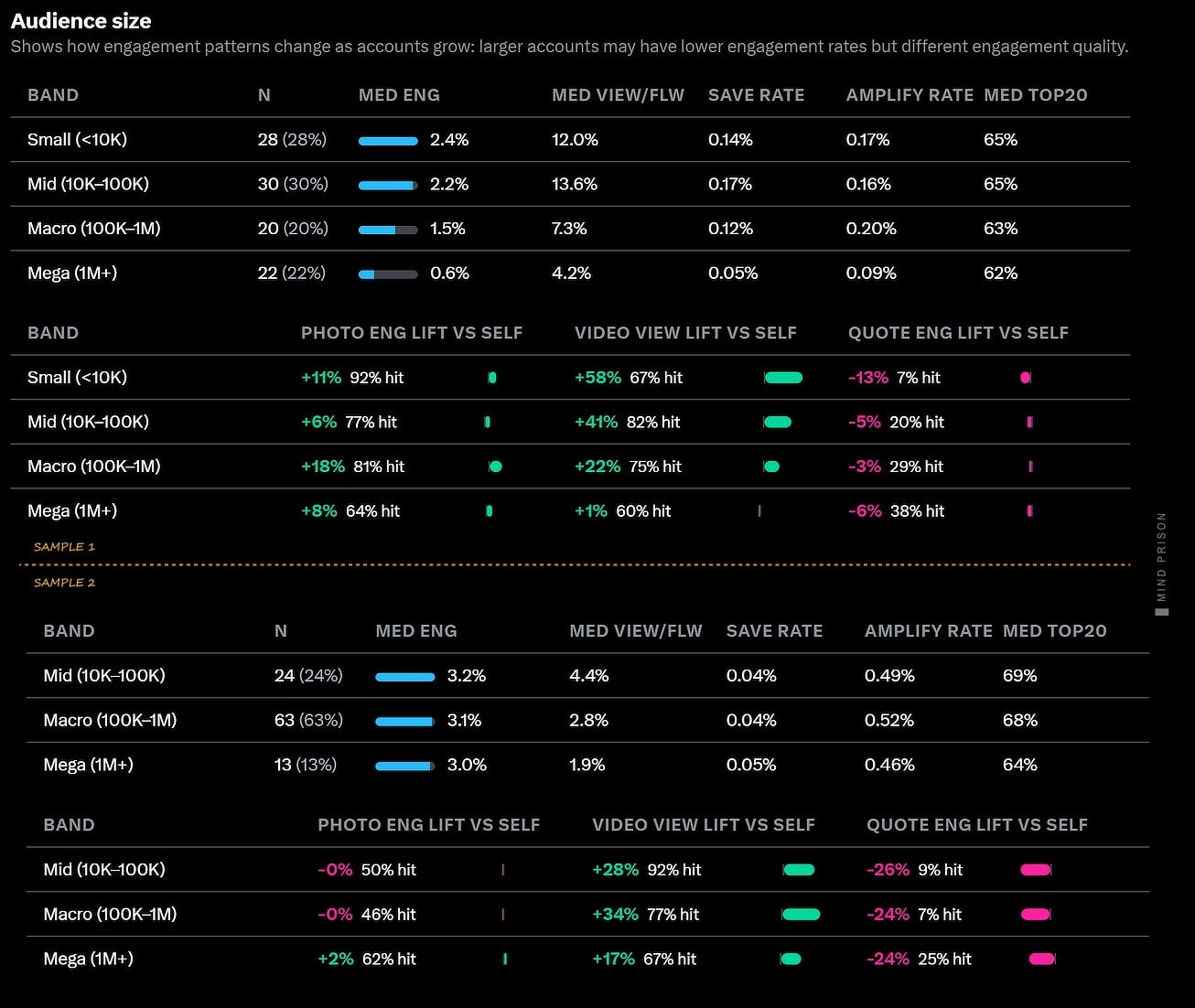
In both samples we see views per follower diminish as account size grows. Engagement rate in the second sample remains mostly steady, but drops in our first sample, but that could be because our first sample was a bit overloaded with outliers as I was seeking unusual engagement patterns to analyze in that sample.
Video trends strongly positive in both samples and quote posts are consistently negative in both samples.
Engagement Effect on Reach
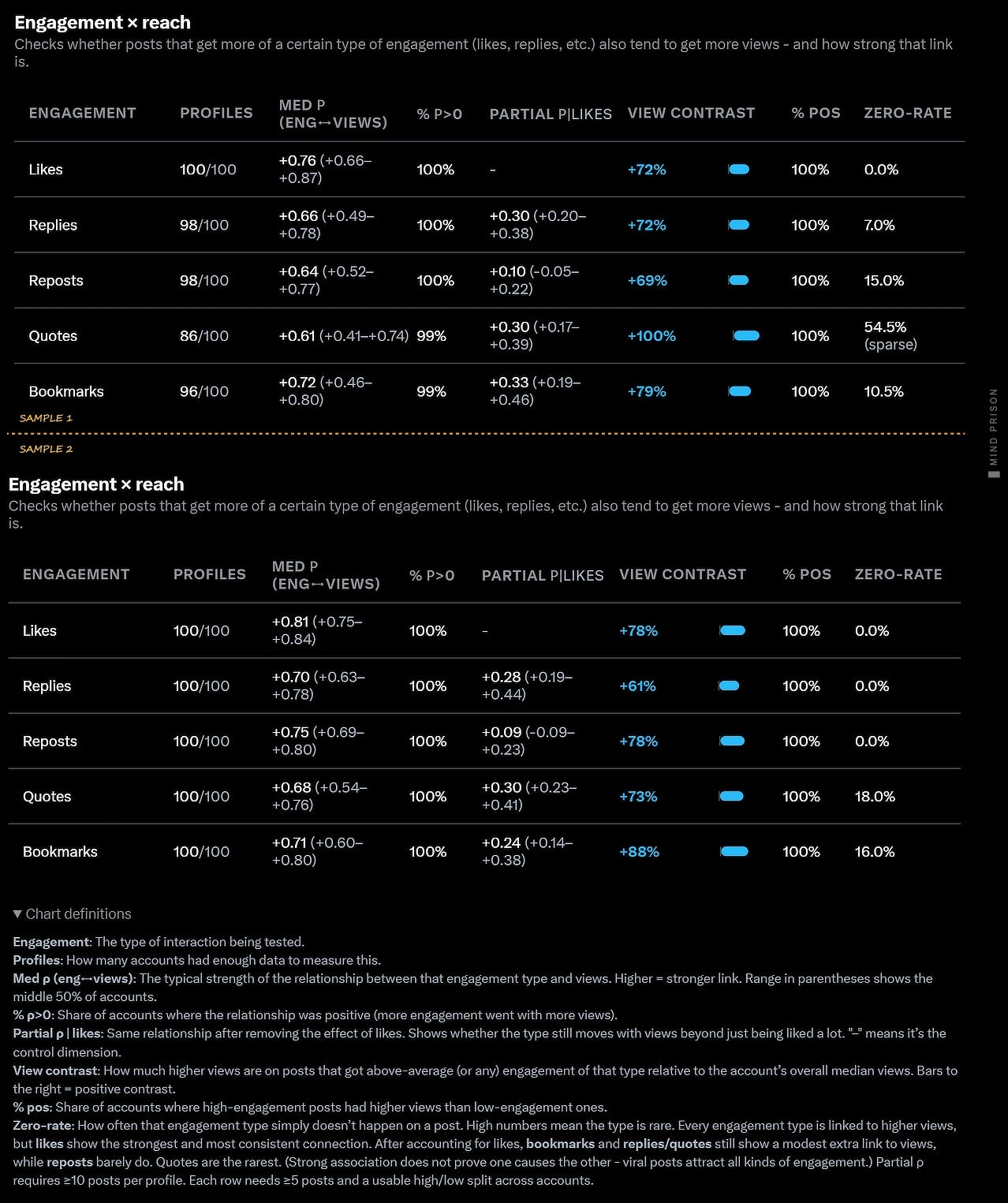
The following is mostly confirmation of what you would expect. Engagement trends with higher numbers of views and is most tightly correlated with likes as the type of engagement. Bookmarks and quotes can give a higher view lift.
Note, quotes are usually a negative effect for your post, but they tend to boost the post that is quoted. This is likely due to the fact that many people will click on the quoted post and engage with it instead of your post. The benefit is essentially transferred.
X Is Not A Meritocratic System Of Ideas
It is where someone will get paid to post “good morning” over and over again: repetitive, low-effort, mind-numbing monotony that far exceeds your reach and engagement.
It is a place where thousands of accounts are posting worse versions of your ideas and getting paid to do so, while you are ignored. It is not free speech; it is algorithmic speech.
It, and all social platforms, are now AI systems that maximize someone else’s vision for correct narratives, social order, and dialogue. And many who are on X are there only because, mostly, everywhere else is an even worse version of all the above.
Social media platforms all state that they are attempting to find the best audience for your post for engagement. That would seem to make sense. But some fail at this task so utterly that it is incomprehensible that they are even trying.
They are monitoring everything about you, all your posts and interactions; they know everything, but apparently cannot find a single other person like you who is interested in what you have to say. How is it possible to be this bad at their goal unless it is on purpose, to ensure that it is a select few who shape society.
Methods and Fine Print
All samples were collected using the X search feature to find the last 100 original posts for a profile. No reposts or replies are counted in this set. Any post less than 24 hours old was skipped.
The collection and analysis were aided by my own X-Filter extension, and some additional work was done separately for the additional senators dataset. The complete X handle list for all 100 US Senators was determined by Grok. It got 98 of 100 correct.
Note that engagement, as calculated in this analysis, will not align with how X calculates your engagement rate. We consider any of the following an engagement: like, repost, quote post, bookmark, or reply. X may consider other attributes, such as a click on the post, which we cannot track.
The dates for sample 1 collection were (2026-07-19 - 2026-07-28) and for the senators dataset ( 2026-07-29 - 2026-07-31). Datasets and additional high-resolution charts can be found here. Datasets can be loaded in the X-Filter extension for interactive inspection.
The code and metrics were assisted and reviewed by multiple AI models. I do not have a team of statisticians to verify, so adjust your confidence in these results accordingly. I claim nothing beyond a cursory best effort.
What’s Next?
Hopefully, this best-effort analysis inspires a proper study with funding by those who have the means to go far deeper and more accurately than I could here. We need greater transparency into how reach and engagement work across all social platforms, because we are letting algorithms shape the entire nature of civilization.
We simply cannot allow our future to be in the hands of black-box algorithms that are secret, which nobody understands, and that have the power to determine the outcome of entire cultures, as well as conflicts that can lead even to war. The algorithm is the death of open meritocracy and instills control over all by a secret, unelected, and permanent society, and hypnotizes the populace into submission via dopamine hooks and rage triggers.
Mind Prison is an oasis for human thought attempting to survive amidst the dead internet. I typically spend hours to days on articles including creating the illustrations for each. I hope if you find them valuable and you still appreciate the creations from human beings you will consider subscribing. Thank you!
No compass through the dark exists without hope of reaching the other side and the belief that it matters …
I'm hoping you're wrong about the following: that social media has "the power to determine the outcome of entire cultures, as well as conflicts that can lead even to war." I don't think I'm alone in having abandoned it after finding general behaviour disgusting. Social media truly brings out the worst in people. A lot of folks use at least one alternative identity to "slam," "slaughter," "crush," anyone who dares contradict or engage with them in a meaningful way. I found many who wouldn't engage with me because I didn't have enough followers to be of value. I saw otherwise intelligent and thoughtful folk behave like savages. On the rare occasion I go on Facebook for Marketplace, I'll still see friends displaying such grotesquely phrased and vulgar sentiments, I lose respect for them. I think it has also eroded friendly curiosity in conversation: I've witnessed folks who went from curious interlocutors to political mic-droppers. So it has sadly affected the real world where folks used to have conversations. I call it "social media damage." It will have to be reckoned with at some point, and our culture will have to adapt to the realization that social media is actively destructive. It should be shunned by politicians: I think it's inappropriate and undignified for any serious individual to engage on these platforms. I know I'm not alone in this assessment, and I'm hoping that in time folks will come round.